
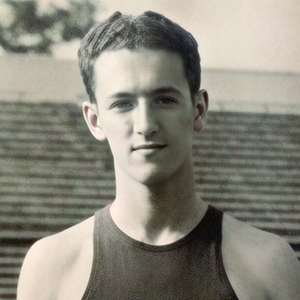
 Charles Hornbostel was born in Evansville, the son of a blacksmith. He grew up with little interest in athletics, but academics were especially important. Living the life of a normal Indiana school environment, basketball became an interest as he entered high school and took up running as a developmental activity to increase his basketball future. However, his running did not get him off the bench. In fact, he won only one race and never broke 5:00 minutes for the mile.
After graduating, he worked as a bank teller for two years earning $20.00 a month and, with less than $13.00, decided to attend Indiana University. During that time, a week’s food was $5.00, and tuition was $500.00 a semester. Charles got a job at a sorority dining hall (as did many athletes at that time, since athletic scholarships were few) where he received free meals and a small salary. Hornbostel tried out for the basketball team with little success. The basketball coach knew a runner when he saw one and encouraged him to try out for the track team. The 880-yards was his event.
His success came very early. Charles never lost a collegiate 880-yard or 800-meter race. He won the Big Ten indoor and outdoor and National Collegiate Athletic Association (NCAA) championships from 1932 to 1934, as well as the 1933 and 1934 indoor and outdoor Big Ten mile championships. In 1932, he made the United States Olympic team that would run in Los Angeles. Charles placed sixth in a time that was faster than the previous world record and returned in 1936 as a member of the Berlin Olympic Games, finishing fifth. He was a member of two world record relay teams: the 4x800 meters and 4xmile. He also set world records in the 800-meters in 1:50.9 and again at 1:49.8 and the 600-yards indoor in 1:11.3.
Returning from the Berlin Olympic Games and a running tour in Europe, he never ran again. Carrying the “Hustling Hoosier” title that had been given him by sportswriters, he never stopped hustling. He began a business career that would lead him to become controller of Hooker Chemical and president of the Financial Executive Institute in New York City.
Hornbostel’s honors were something that he did not expound on. In fact, his three daughters were adults before they learned of his athletic successes.